
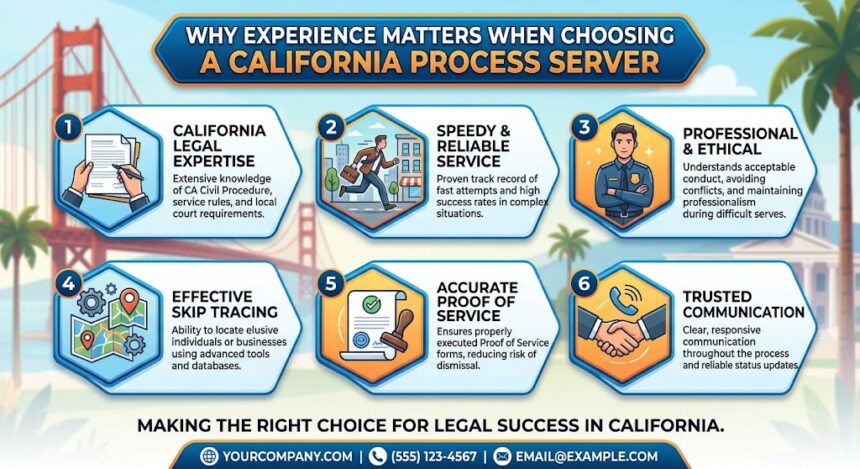
A California filing moves forward once the summons reaches the person named in it, and the court expects proof of that within weeks. Who carries the papers is often the last decision anyone expects to matter. The sections below take the role apart — the duties behind the delivery, the parts belonging to California alone, and what a seasoned provider does once an address proves wrong.
Process Service Is More Than Delivering Papers
Handing over papers is the visible part of a job the court reviews afterward. Three obligations run alongside it:
- Method. California service of process recognizes personal delivery, substituted service, and service by mail, and the route chosen sets the date service counts as complete: the day of delivery, ten days after the follow-up mailing, or five days after mailing, respectively.
- Record. A proof of service states how, when, and where the papers were served and who received them, so the value of a visit depends on what the server wrote down at the time.
- Conduct. Attempts happen at people’s homes and workplaces, and a server who argues at the door or overstates who they are hands the other side an argument.
The person hired to serve legal documents that California courts will act on is therefore writing a document as well as carrying one. That second document is what gets read when service is questioned.
California-Specific Knowledge Matters
California process service runs on statutory methods, while each superior court adds local rules of its own on top. A California process server working here week after week tends to know both.
Some of that knowledge is written down and can be checked before anyone is hired. Four points come from California itself:
- Registration with a county clerk, required of a natural person who makes more than ten services of process in California during a calendar year for compensation.
- A $2,000 bond running two years, filed with that registration, alongside one year of California residency before the filing date.
- The registration number and issuing county, which belong on the completed proof and can be checked against the registration record.
- Document type, since a family-law paper, a subpoena service in California assignment, and a summons can differ in who may be served and what the proof of service has to show.
A search for a licensed process server in California usually points to this arrangement, since the state works through county registration rather than a license. The server’s registration number and county can be checked before the papers are sent out.
How Experience Helps With Difficult Serves
Addresses go stale, gates stay shut, and some recipients would rather not be found. What separates providers is the sequence that starts after the first visit fails.
Difficult process service runs on planning rather than promises. Substituted service becomes available after reasonable diligence, which in practice means at least three attempts on different days and at different hours, so the failed visits themselves build the route to a lawful alternative.
A file like that is where experienced process servers in California earn the description — skip tracing, attempts outside office hours, and a plan for the court application if those come to nothing. The steps run in order, so someone who has worked through them before tends to know which one a judge will want documented.
Rush process servers in California compress that sequence rather than skipping steps in it. Anyone who promises a completed service by a date without having seen the address is describing a hope, while a provider who asks what the recipient looks like, when they are likely at home, and where else they can be found is planning the visits.
Communication and Documentation Standards
Legal document delivery that goes quiet costs a firm more than delivery that goes slowly. Updates arriving without being chased give the firm time to ask the court for more time or to move a hearing.
Attempt notes carry the details — date, hour, address, what the server observed, and what was said at the door. Those entries support the document of due diligence that substituted service rests on.
Proof of service is a record that California courts accept showing how, when, and where the papers were served and who received them. Timing matters here too, since Rule 3.110 of the California Rules of Court requires the complaint to be served and proofs filed within 60 days of the complaint being filed, and within 30 days for a cross-complaint adding new parties.
Questions to Ask a California Process Server
A short call before instructing separates most providers from each other. Five questions tend to be enough:
- How long have you worked in this county, and which courts do you file in most often?
- Are you registered, and what is the number and issuing county?
- What does your attempt schedule look like before substituted service becomes an option?
- When do updates reach me, and what do they contain?
- Who prepares the proof, and how soon after a completed service does it reach the court?
Process server qualifications are straightforward to check because registration is a public record held by the county clerk. The answers to the other questions show whether someone has handled files like yours before, which tends to determine how a difficult one ends.