
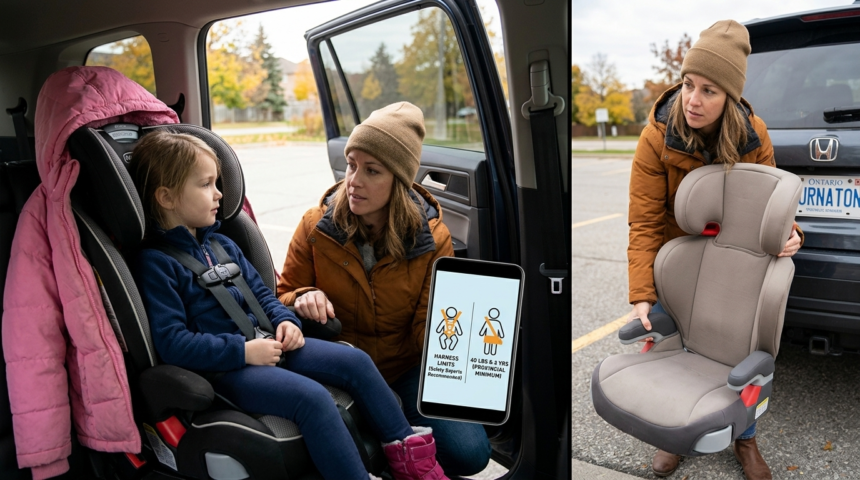
Picture this: your four-year-old has hit 40 pounds, and every parent at daycare seems to have already moved their kid to a booster seat. So you start wondering whether you’re behind. You’re not and that assumption is exactly the kind of pressure that leads Canadian families to make the switch too soon.
Understanding booster seat Canada requirements means knowing the difference between what provincial law permits and what safety experts actually recommend. Those two things are not the same, and the gap matters more than most parents realize.
The Law Sets a Floor, Not a Finish
Most Canadian provinces allow children to move to a booster seat once they reach 18 kg (40 lbs) and are at least four years old but the rules vary by province. Ontario requires booster use for children under eight who weigh less than 36 kg and stand under 145 cm. British Columbia and Quebec mandate booster use until age nine or 145 cm in height. Alberta sets a minimum exit age of six.
These are legal minimums. They tell you the earliest point at which a transition is permitted, not the safest point at which it should happen. The Canadian Pediatric Society recommends keeping children in a five-point harness seat for as long as that seat allows not switching the moment the child qualifies by weight or age alone.
Knowing your province’s rules is the starting point. Building the decision around child safety expert guidance is what comes next.
Three Signals That Actually Mean Your Child Is Ready
The most reliable readiness checklist has nothing to do with a birthday it has three parts, and all three need to be true before you make the switch.
- Your child has outgrown the forward-facing harness seat
A child should stay in a five-point harness seat until they reach the height or weight limit on that specific seat not just until they hit the minimum booster entry weight. There is no safety downside to remaining harnessed past the minimum. The harness controls the child’s body in ways a seatbelt cannot replicate at this stage.
- Your child passes the seatbelt fit test
Even in a booster, the seatbelt must fit correctly every time. The lap belt needs to lie flat across the upper thighs and hips, not the abdomen. The shoulder belt must cross the center of the chest and collarbone, staying clear of the neck. If these five fit criteria fail, the child is not ready for a booster regardless of their age or weight.
- Your child can sit still for the full journey
Booster seats rely entirely on the child sitting upright and not tampering with the belt. A child who routinely slips the shoulder belt behind their back, tries to unbuckle mid-trip, or slumps forward has not yet developed the behavioral readiness the booster stage requires. Staying in the harness a few extra months while this behavior becomes consistent is always the safer call.
The Canadian Winter Detail Most Guides Skip
Canada adds a layer most guides ignore: bulky outerwear. In a crash, a winter coat compresses rapidly, creating dangerous slack between the seatbelt and your child’s body. Remove the coat before buckling, drape it over their front afterward, and use the pinch test if you can grasp excess fabric at the shoulder belt, the coat must come off. A thin fleece is fine. This applies year-round.
High-Back or Backless: The Practical Choice
In Canada, both booster types are certified to CMVSS 213.2, so neither is categorically safer. The decision rests on two factors: your vehicle’s headrests and your child’s behavior. A backless booster can only be used where the vehicle headrest reaches the tops of your child’s ears many middle seats and third-row positions in older vehicles fall short, making a high-back mandatory there. A high-back is also the better starting point for any child who has just left a harness, since its belt guides maintain correct shoulder belt position even when the child shifts or dozes.
For families in Montreal and across Canada, the booster car seats at Kido Bébé include high-back and 2-in-1 convertible models from Nuna, Britax, and UPPAbaby all Canadian-market units carrying the National Safety Mark required for legal use in Canada. Seeing the seat in person with your child is one of the few ways to assess headrest height, belt routing, and seat width together before committing to a model.
When Does the Booster Stage End?
A child can stop using a booster when the adult seatbelt fits correctly without it typically at 145 cm (4 ft 9 in), which most children reach between ages nine and twelve. The seatbelt fit test is the governing criterion, not a birthday. The Canadian Paediatric Society recommends continuing booster use until all five fit criteria pass consistently, and Transport Canada recommends all children 12 and under ride in the back seat even after the booster stage ends.
The full car seat collection at Kido Bébé covers every stage from infant carrier to booster, with in-store guidance available at 4100 Boulevard Thimens, Saint-Laurent, Montreal for families who want a hands-on fit assessment.
The Bottom Line
The most common booster seat mistake in Canada is making the switch too early because the law permits it. Provincial rules set the minimum, not the safest point. Your child’s harness limits, seatbelt fit, and consistent riding behavior are the signals to follow. When all three are genuinely met, a properly fitted booster is an excellent next stage. Until then, the harness is doing exactly what it is built to do.
What has your experience been with the car seat transition? Share your questions below every family’s situation is a little different.