
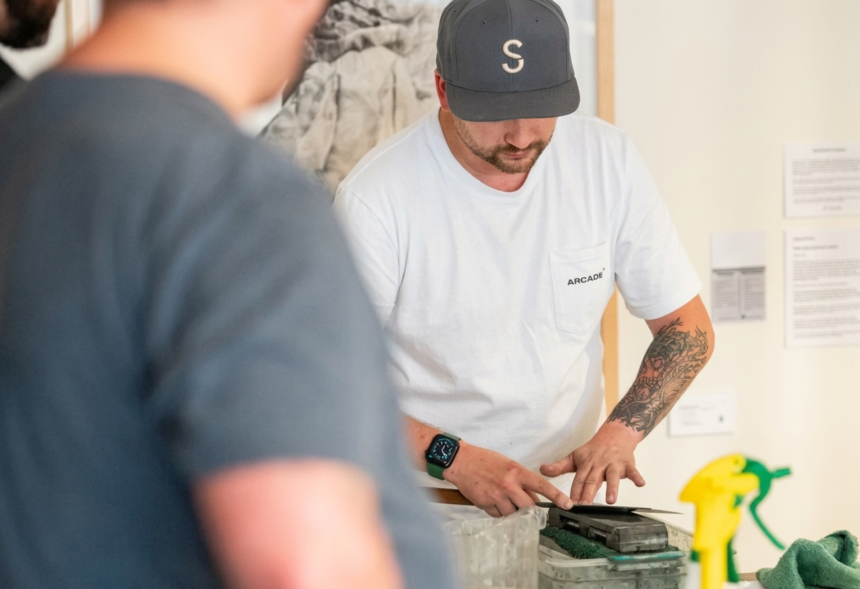
A Japanese knife that stops cutting well isn’t always a worn-out knife. More often, it’s an edge that simply hasn’t seen a water stone in a while. Unlike softer Western steel, Japanese steel is sharpened progressively, moving through a sequence of grits to bring back a clean, lasting edge.
The process looks technical at first, but it comes down to a handful of repeatable moves once the angle and motion click. This guide walks through sharpening on a water stone step by step, from soaking the stone to checking the final edge, so any home cook can bring a Japanese blade back to a reliable working edge without relying on a shop for routine upkeep.
Getting Your Setup Ready
Sharpening on a water stone doesn’t take much gear, but every piece matters. A water stone suited to the steel, a non-slip base or a damp towel to keep it steady, and a towel to wipe the blade between passes.
Stay Sharp’s selection of Japanese water stones makes it easy to pick a grit based on how dull the edge already is: something around #1000 covers routine sharpening, while a very dull blade needs a coarser stone as a first pass. A dedicated stone holder also helps, since a wobbling stone makes it harder to keep a steady angle.
Soaking the Water Stone
Before anything else, the stone needs to sit in water until it stops releasing bubbles, usually 10 to 15 minutes depending on the grit. A stone that hasn’t soaked long enough wears unevenly and drags on the blade. Keep the surface wet throughout the sharpening, adding water with your fingers or a spray bottle as needed.
Finding the Sharpening Angle
Most double-bevel Japanese knives are sharpened at a fairly tight angle, often somewhere between 12 and 15 degrees per side, though the exact angle depends on the model and blade profile. A tighter angle favors a finer but more fragile edge; a slightly wider angle gives a marginally less keen edge that holds up better to everyday use.
To find the angle without a measuring tool, lay the blade flat on the stone, then lift it slightly until you feel the edge make contact rather than the spine. Once you’ve found that position, keep it steady for the full length of the stroke, since even small shifts change how the edge forms.
The Sharpening Motion, Step by Step
Once the angle is set, move the blade in a sweeping motion from heel to tip, with light, even pressure. Work one side for roughly ten to fifteen strokes, keeping the same angle throughout.
Then check for a light burr forming on the other side of the blade: that faint catch is the sign the steel has been worked enough on that side. Repeat the same number of strokes on the other face, with slightly lighter pressure to even out the edge.
Moving to Finer Grits
After a coarser stone, a finer grit, around #3000 to #6000, refines the edge and removes the micro-burrs left by the first stone. This step isn’t required for routine upkeep, but it noticeably improves the feel of the cut on fibrous or delicate ingredients. The motion stays the same, just with even lighter pressure than the previous step.
Finishing on Leather and Checking the Edge
Once sharpening is done, a pass on a leather strop removes the last traces of loose steel and aligns the edge without removing any material: that’s what’s known as honing, a separate step from stone work and generally a quicker one.
To check the result, try cutting a sheet of paper held in the air: a well-sharpened edge slices through cleanly, without tearing. For badly damaged blades, or simply when time is short, it’s also possible to hand this step over to Stay Sharp’s water stone sharpening service.
Common Mistakes to Avoid
An angle that drifts from one stroke to the next is the most common cause of an uneven edge; it’s better to slow the motion down than to keep it fast at the expense of precision. A stone that hasn’t soaked enough, or that’s left to dry out mid-session, drags on the blade and wears unevenly.
Pressing harder doesn’t speed up sharpening: it deforms the edge instead of refining it. Light, even pressure over enough strokes gives a cleaner result than heavy pressure over just a few passes.
Rushing the last few strokes is another common slip: the final passes on a fine grit matter more for the finished edge than the first ones on a coarse stone, so it’s worth slowing down rather than speeding up toward the end.
Between Sharpenings
A Japanese knife holds its edge longer when it’s wiped after every use, stored away from moisture, and used on a wooden cutting board rather than glass or stone. Avoiding the dishwasher and hard surfaces limits edge wear between water stone sessions.
How often do you sharpen your knives at home, and what grit do you usually reach for?