
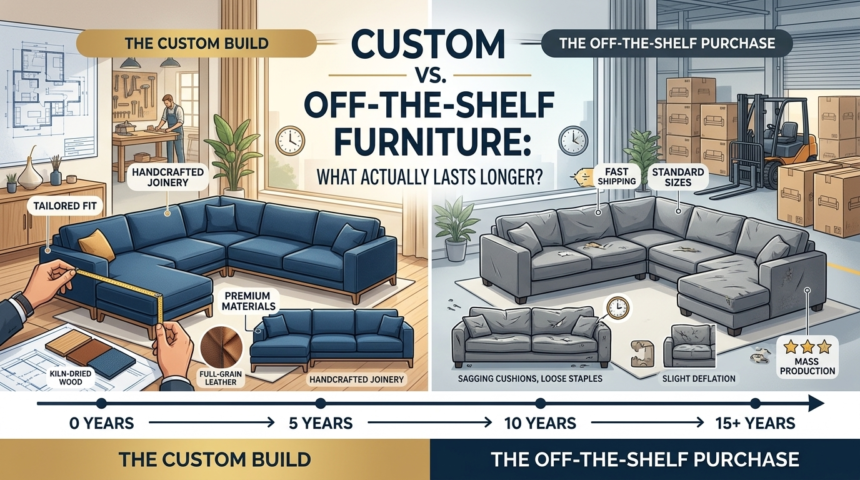
Every piece of furniture looks equally sturdy on a showroom floor. Five years later, one sofa still holds its shape while another has sagged, wobbled, or been replaced twice already. The difference rarely comes down to price alone. It comes down to how the piece was actually built, and whether it was built for a general market average or for your specific room. Here’s how custom and off-the-shelf furniture really compare once the delivery truck leaves.
The Core Tradeoff: Fit vs. Speed
Off-the-shelf: Off-the-shelf furniture ships from existing stock in fixed sizes, so it’s typically ready within days rather than weeks. That speed comes at the cost of flexibility, since each piece was designed to suit a broad range of rooms rather than yours specifically.
Custom: Custom furniture is built after you place the order, around your chosen dimensions, material, and configuration. That precision takes longer to deliver, but it removes the guesswork of hoping a standard size happens to work in an unusual room.
Construction Quality: Where the Real Difference Shows Up
What Off-the-Shelf Construction Usually Looks Like
Pros:
- Faster turnaround, since pieces come from ready stock rather than a production queue that starts only after your order is placed.
- Often more budget-friendly upfront, which suits short-term furnishing needs or a first apartment on a tight timeline.
Cons:
- Construction quality varies significantly across similar price points, even within the same store or the same season.
- Frame and cushion materials are rarely disclosed clearly on the tag, which makes it hard to judge longevity before you buy.
What Custom Construction Usually Looks Like
Pros:
- Frames are typically built individually with more deliberate joinery, since each piece isn’t part of a mass production line.
- Material choices, such as kiln-dried hardwood or full-grain leather, can be selected specifically for durability rather than cost efficiency.
Cons:
- Lead times commonly run from several weeks to a few months, which doesn’t suit an urgent furnishing deadline.
- Pricing is less predictable upfront, since the final cost depends on the exact materials and configuration chosen.
Showrooms that display a full custom sofa collection alongside ready-made pieces make this difference easy to see and feel firsthand, rather than taking a sales pitch’s word for it. Sitting in both, side by side, tends to settle the debate faster than any spec sheet.
Lifespan: What Five, Ten, and Twenty Years Actually Look Like
Off-the-Shelf Over Time
A ready-made piece built to a general market average often needs replacing or reupholstering within five to eight years of regular use. Frame joints and cushion support tend to be the first areas to show real wear, especially in households with kids, pets, or frequent guests.
Custom Over Time
A custom piece built around a household’s specific habits can hold its shape and comfort for well over a decade. The frame and fill were chosen for that exact use pattern rather than for a general audience, which tends to show up in how gracefully the piece ages under daily use.
Warranty and Repairs: The Part Buyers Forget to Ask About
Off-the-Shelf Warranty Coverage
Warranty terms on ready-made furniture are often shorter and cover fewer components, since the manufacturer is producing at volume for a broad market. Frame, springs, and upholstery are sometimes bundled under one general term rather than covered separately.
Custom Warranty Coverage
Custom pieces more often separate warranty coverage by component, frame, springs, foam, and upholstery each with their own terms and duration. Replacement parts also tend to come directly from the original maker, which keeps repairs precise even years after the original purchase.
Cost Over Time, Not Just at Checkout
The sticker price only tells part of the story. A cheaper piece replaced twice in ten years can cost more overall than a single, well-built piece that lasts the full decade without sagging, loosening, or losing its original shape.
Factor in reupholstery and repair costs too. A solid custom frame is often worth re-covering years down the line, while a weaker frame rarely justifies the expense once the fabric on it finally wears through.
Resale and hand-me-down value follow the same pattern. A well-built frame is usually worth reupholstering and passing on, while a weaker frame typically isn’t, no matter how good the fabric on top still looks.
Which One Actually Wins?
Neither path is universally better. It depends on your timeline, your room’s shape, and how long you actually plan to keep the piece before replacing it.
If you need seating within weeks, off-the-shelf will win every time, and there’s nothing wrong with that choice for a transitional space. If you’re furnishing for the long haul, or your room refuses to cooperate with standard dimensions, the custom route tends to pay for itself in fewer replacements down the line.
Many buyers land somewhere in between, choosing one custom anchor piece and filling in the rest with ready-made furniture, white-glove delivery included, once the big decisions are settled.
Which side of this tradeoff matters more to you: speed, or fit built to last? Let us know in the comments.