
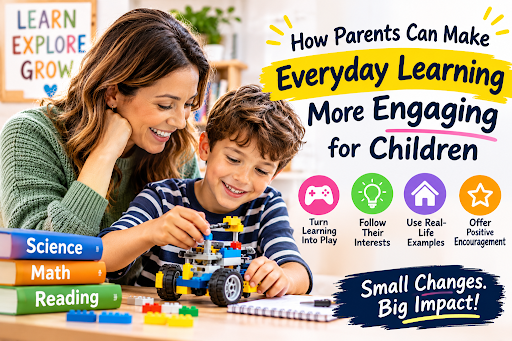
Think about the last time your child asked you “but why?” about something you’d never really stopped to wonder about. Children come into the world curious. They poke, prod, question and explore, and they often learn the most when they think they’re just playing.
Then school gets busier. Homework piles up, tests appear on the calendar, and somewhere along the way learning can start to feel like a chore rather than an adventure. If that sounds familiar, you’re not alone, and the good news is that you can do a lot to turn things around at home.
You don’t need fancy tools or a perfect timetable. Small things go a long way: chatting about the day, reading together, playing a few games, and keeping a gentle routine. Together, they help children grow in curiosity, confidence and a happier attitude towards learning.
And no, the goal isn’t to turn every moment into a lesson. It’s to build a home where your child feels safe asking questions, trying ideas out, getting things wrong, and enjoying that little spark of “oh, now I get it!”
1. Turn Everyday Activities into Learning Opportunities
Some of the best lessons never happen at a desk. Ordinary days are packed with chances to practise useful skills, often without anyone noticing.
Baking a cake together? That’s measuring, fractions, counting and following instructions in one go. A trip to the shop can turn into a lesson on comparing prices, adding up the total and understanding what money is worth. And a bit of gardening quietly teaches children about plants, weather, insects and the world around them.
The trick is to ask a simple question or two along the way, and then let your child think.
In the kitchen, you might say, “The recipe needs two cups of flour for one batch. How much do we need if we make two?” On a walk in the park, you could wonder aloud why some plants seem to love the sunny spots more than the shady ones.
Moments like these teach children to notice things, work out answers for themselves, and use what they know in real life.
2. Make Reading an Enjoyable Daily Habit
Reading builds vocabulary, understanding, imagination and communication skills. But here’s what matters most: children enjoy reading far more when they get to pick what they read and share it with someone they love and trust.
A daily reading habit doesn’t have to be long. Setting aside 15 to 20 minutes for books, short stories, poems or age-appropriate non-fiction is plenty.
With younger children, reading aloud is wonderful. Do the character voices (the sillier, the better), stop to look at the pictures together, and ask what they think will happen next. Older children may prefer to read on their own first and then chat with you about their favourite parts.
After a story, you could try asking:
- What was the most interesting part of the story?
- Why do you think the character made that decision?
- What would you have done differently?
- What do you think happens after the ending?
Questions like these nudge children to think beyond the words on the page.
If you’re hunting for stories, poems and reading activities that suit your child’s age, you can browse these free short stories and reading resources for kids. When the material matches your child’s interests and reading level, sticking with the habit gets a lot easier.
3. Use Educational Games to Reinforce Learning
Play is one of the nicest ways to practise a skill, because it doesn’t feel like schoolwork. Games can help children spot patterns, solve problems, remember things and grow their language skills, all while having fun.
What works best depends on your child’s age, interests and what they’re currently learning. Here are a few ideas to get you started:
- Number games: Use dice, playing cards or everyday objects to practise counting, adding, subtracting and recognising numbers.
- Word games: Build words together, try some age-appropriate riddles, or see who can find the most words starting with a certain letter.
- Memory games: Place a few objects on a tray, cover them up, and ask your child to remember what was there.
- Science activities: Guess which things will float or sink, watch how shadows change through the day, or grow a small plant and keep a record of how it’s doing.
- Problem-solving challenges: Build a tower with blocks, work on a puzzle, or challenge your child to find a few different ways to solve a simple problem.
Digital educational games can have a place too, in moderation. Look for ones that make your child think, decide and solve problems, rather than ones where they just watch animations or keep tapping the screen.
Most of all, keep it fun. Celebrate the effort, the curiosity and the “let me try once more” spirit, rather than just winning or getting every answer right.
4. Create a Comfortable and Consistent Study Routine
As children move up through school, they need to learn how to work on their own. A predictable routine helps them know what to expect, and it still leaves room for rest, play and family time.
Start with a quiet, comfortable spot where your child can read, finish assignments and go over lessons. Keep the essentials close by and try to cut down on distractions.
A simple after-school routine could look like this:
- Unwind with a break and a snack after school.
- Go over the day’s lessons and finish the important assignments.
- Spend a little time reading, trying practice questions, or tackling a tricky topic.
- Take short breaks between focused study sessions.
- Pack books and materials for tomorrow.
Of course, every child is different, so adjust the routine to suit your child’s age and workload. Younger children usually do best with shorter sessions, while older students can often focus for longer.
If your child could use a little extra guidance, these practical study techniques for students offer helpful ideas for organising revision, practising active recall and building better study habits.
5. Encourage Questions Instead of Always Giving Answers
Every parent has been stumped by a child’s question at some point. Instead of seeing that as a problem, try seeing it as a lovely chance to show your child what curiosity looks like.
Say your child asks why the Moon seems to change shape. You could start by asking what they’ve noticed in the night sky. Talk through a few ideas together, look it up in a trusted book, or explore a child-friendly resource side by side.
This shows children that learning is about investigating and discovering, not just memorising facts.
You can nurture this habit with questions like these:
- What do you think is happening?
- What makes you think that?
- How could we find out?
- Can you think of another explanation?
- What did you discover?
It also helps to give your child a moment to think before you jump in. It can be hard to wait, but sitting with a bit of uncertainty builds patience, reasoning and confidence.
6. Help Children Learn from Mistakes
A wrong answer doesn’t mean a child can’t learn. More often, it simply shows which idea needs a bit more practice or a clearer explanation.
When your child struggles with a maths problem or slips up in a piece of writing, try to hold back the urge to correct them straight away. Instead, ask them to walk you through how they got there.
That makes it much easier to see what really went wrong. Maybe they didn’t understand the concept, forgot a rule, missed an instruction, or just rushed.
You can help your child see mistakes as part of learning by saying things like:
- “Let’s see where it started to go off track.”
- “You already understand part of this. Let’s try the next step together.”
- “What could you try differently?”
- “You’ve improved because you kept practising.”
When you notice progress, persistence and real effort, children begin to believe that skills grow with practice.
7. Balance Screen Time with Hands-On Activities
Digital tools can make learning easier to reach, but children also need to run around, talk with people, explore the world and let their imagination wander.
You can set sensible limits on recreational screen time and leave plenty of space for outdoor play, drawing, building, music, sports and little hands-on experiments.
When your child uses educational apps or websites, it helps to join in now and then. Ask what they learned, let them teach you how a game works, or encourage them to try an idea out away from the screen.
For example, a child who has been practising shapes on a tablet might enjoy going on a shape hunt around the house, looking for circles, triangles, rectangles and more.
The point isn’t to ban technology. It’s to connect what children learn on screen with the real world around them.
8. Build Confidence Through Small, Achievable Goals
Big assignments and unfamiliar subjects can feel overwhelming, especially when a child has no idea where to begin.
You can help by breaking the task into smaller steps. Instead of saying, “Finish the whole chapter,” you might suggest reading two pages, answering a few questions, and then taking a short break.
Simple goals that feel doable work best, such as learning five new words, practising multiplication for ten minutes, or reading one short story.
Afterwards, talk about what went well and what they might do differently next time.
Every small win helps children see how far they’ve come, and makes the next challenge feel a little less scary.
9. Show Interest in What Children Are Learning
Children love it when their parents are genuinely interested in what they’re learning, as long as it doesn’t feel like a quiz.
Instead of only asking whether the homework is done or what marks they got, try asking, “What was the most interesting thing you found out today?”
You could also invite them to show you a science experiment, explain a new word, tell you about a moment in history, or teach a family member how to solve a problem.
When children explain something in their own words, they sort out their thoughts and notice what they still don’t quite understand.
And when your child talks about something that’s hard, listen closely. A kind, open conversation can help you work out whether they need more practice, a different explanation, or a word with their teacher.
10. Make Learning a Shared Family Experience
Children learn a great deal by watching the adults around them. When they see you reading a book, following a new interest, solving a real problem, or admitting that there’s something you need to learn, they discover that learning doesn’t stop when school does.
Try bringing in some simple shared activities: a weekly trip to the library, a nature walk, a family quiz, a cooking project, or an evening when everyone shares one interesting thing they found out that day.
None of this needs to be expensive or elaborate. What matters is the time you spend together, the conversations that follow, and the chance for your child to explore what they love.
It’s also worth remembering that every child is different. One may love books, another may be happiest building things, and another may learn best through talking or moving around. Trying a variety of activities helps you discover what lights up your child.
Conclusion
Helping your child enjoy learning doesn’t take expensive resources, complicated methods or hours of extra study. More often than not, it starts with small habits that you keep up consistently.
Reading together, playing games, asking thoughtful questions, building a realistic routine and celebrating progress can make learning feel more engaging and a lot more rewarding.
Above all, children need to feel free to explore ideas without being afraid of getting things wrong. When home is a warm, supportive place that balances learning with rest, play and close relationships, children build skills that stay with them well beyond the classroom.
A child’s educational journey isn’t only about finishing assignments or earning high marks. It’s also about growing curious, independent and resilient, and holding on to a lifelong love of learning.


