
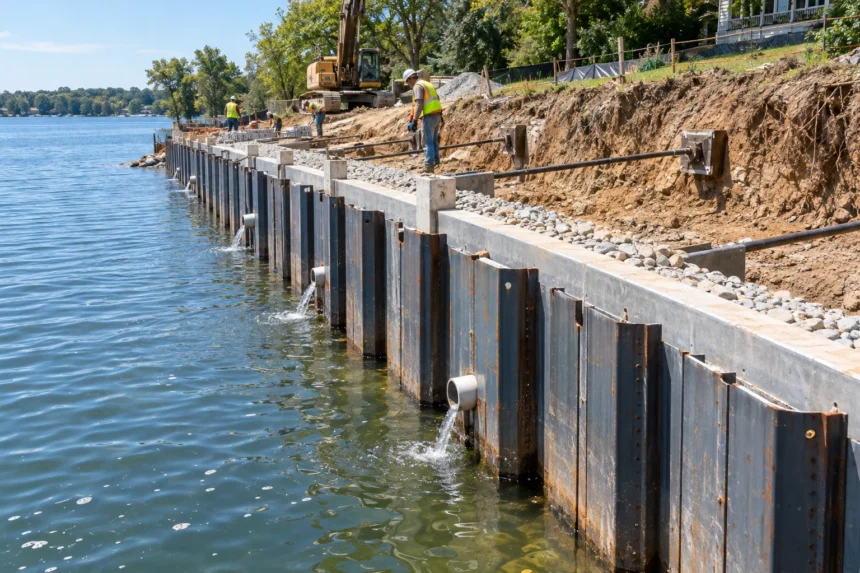
A bulkhead is often described by the material visible from the water, but its performance depends on several systems working behind and below that face. Shore Protect Team identifies drainage systems, tie-back anchors, and pile driving as parts of bulkhead construction. Each handles a different condition.
The company’s marine shoreline services services include piling installation and shoreline structures, which helps explain why the wall face should not be separated from its foundation. The structure has to manage water, soil, and support at the same time.
Drainage is used to prevent groundwater pressure from building behind the wall. Tie-back anchors are used to prevent displacement under soil pressure. Piles provide the foundation support, with depth influenced by soil conditions.
These functions overlap in the sense that they all contribute to the same bulkhead, but they are not interchangeable. Deeper piles do not provide a drainage path. Drainage does not restrain the wall against soil pressure. Anchors do not replace the foundation.
The page also notes that soft soils require deeper piles and that the number of tie-back anchors depends on bulkhead height and soil type. That means the interaction among these systems is determined by the site rather than by a standard component count.
The bulkhead structural systems should therefore be read as a complete assembly of material, foundation, restraint, and water management. A proposal that names only the visible wall material leaves out important parts of the design.
Piles create the foundation
Pile depth is tied to soil characteristics. Where soil is soft, the service page states that deeper piles may be required. The foundation supports the wall and allows the design to respond to the conditions below the shoreline.
Pile installation also depends on equipment access. A structurally correct foundation still has to be constructible at the property, which is why site accessibility is listed as a separate cost factor.
Tie-backs restrain the wall
Tie-back anchors address the retained soil behind the bulkhead. Their purpose is to prevent displacement under soil pressure. The number required depends on wall height and soil type, so the anchor plan has to be connected to the geometry and ground conditions of the site.
This is different from the role of the piles. Piles support the structure from below, while tie-backs provide restraint from behind. Both can be necessary on the same wall.
Drainage manages water behind the structure
Groundwater in the retained soil can place pressure on the wall. Drainage systems are installed to relieve that pressure and, according to the page, help extend service life. Drainage therefore responds to water that is behind the wall rather than the waves or currents in front of it.
- Piles – Provide foundation support, with depth influenced by soil conditions.
- Tie-back anchors – Resist displacement caused by soil pressure.
- Drainage – Relieves groundwater pressure behind the wall.
- Wall material – Provides the visible shoreline barrier and is selected for exposure, maintenance, and use.
- Access – Determines how the foundation and structural components can be installed.
Why one strong component cannot compensate for another
A project can have a durable wall material and still require proper drainage. It can have deep piles and still need tie-backs. It can include anchors and still need a foundation appropriate for the soil. The bulkhead should be reviewed as a system in which each component solves a specific problem.
This system approach is particularly useful when evaluating repairs. If a wall has visible damage, the contractor can review whether the cause or associated condition also involves anchors, drainage, or foundation support.
- Identify the soil conditions that influence pile depth.
- Measure the wall height and retained conditions that affect anchor planning.
- Review groundwater conditions behind the wall for drainage needs.
- Match the wall material to the water body and exposure.
- Confirm that equipment can reach the locations where structural work is required.
- Describe all systems in the proposal instead of pricing only the wall face.
How to compare two bulkhead designs
Owners should compare more than material names. One proposal may use the same vinyl or wood face as another while specifying different pile depths, anchor quantities, or drainage work. Those differences can explain both price and performance expectations.
A complete comparison asks what each component is intended to control. Once piles, anchors, drainage, material, and access are separated by function, the project scope becomes much easier to understand.
System failures should be diagnosed by function
When a bulkhead develops a problem, the visible symptom does not automatically identify the failed component. Movement can involve restraint, support, soil conditions, or a combination of factors. Water behind the wall points to a different question than deterioration of the wall material itself. A functional breakdown keeps the diagnosis from jumping directly to one repair item.
Owners can organize observations into categories: wall face, foundation, restraint, drainage, and access. The contractor can then explain which category is responsible for the proposed work and whether other systems remain serviceable. This is more informative than a repair description that simply says “reinforce bulkhead.”
The same framework is useful for new construction because it shows why each component exists. Piles are not included because every bulkhead looks similar, and anchors are not added as a standard accessory. Each component should be connected to a site condition or structural function documented in the project.
Documenting the system makes future repair easier
Owners benefit from keeping a record of the original pile, anchor, drainage, and wall configuration after construction. If a problem appears years later, that information helps distinguish the components that were installed together from later repairs or modifications. A documented system is easier to evaluate than a wall whose hidden structural details are unknown.


