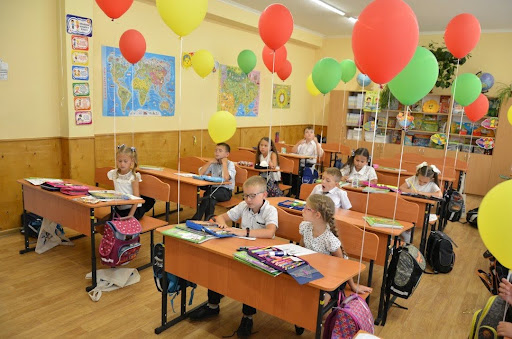
Fostering academic excellence across the K-8 spectrum is a multifaceted endeavor, built upon several interconnected pillars that support a child’s holistic development. It’s not merely about rote memorization or achieving high scores, but about cultivating a deep love for learning, critical thinking skills, and the resilience to navigate challenges. This journey begins in the earliest years, where foundational experiences shape future academic trajectories.
Structuring an Early Foundation for Fostering Academic Excellence in K-8 Education
The bedrock of K-8 academic excellence is laid during the preschool years. A robust early foundation encompasses more than just basic ABCs and 123s; it involves a comprehensive approach to a child’s cognitive, social, and emotional growth. Early literacy development, for instance, extends beyond recognizing letters to include phonological awareness, vocabulary acquisition, and a genuine appreciation for stories. When children are exposed to a language-rich environment from an early age, they develop stronger communication skills, which are vital for comprehension and expression throughout their academic careers.
Similarly, numeracy foundations established in preschool are crucial. This involves understanding basic concepts of quantity, patterns, and problem-solving through hands-on activities, rather than abstract drills. Play-based integration is key here, allowing children to explore mathematical concepts naturally and joyfully. Whether it’s counting blocks, sorting toys by size, or recognizing shapes in their environment, these experiences build the neural pathways necessary for more complex mathematical reasoning in elementary school.
Kindergarten readiness, therefore, becomes a natural outcome of these foundational experiences. It signifies a child’s preparedness not just academically, but also socially and emotionally, to thrive in a structured learning environment. Fine motor skills, developed through activities like drawing, cutting, and manipulating small objects, are essential for handwriting and other classroom tasks. Sensory learning, engaging all five senses, allows children to construct a deeper understanding of the world around them, fostering curiosity and a proactive approach to learning. We recognize that high-quality early education, including options like affordable private preschools, can significantly contribute to this critical early foundation, setting children on a path toward continuous academic growth.
Integrating Social-Emotional Learning with Academic Rigor
Academic excellence is incomplete without a strong social-emotional foundation. Children who possess well-developed emotional regulation skills are better equipped to manage frustrations, adapt to new situations, and engage constructively with peers and teachers. This capacity for self-regulation directly impacts their ability to focus, follow instructions, and persist through challenging academic tasks.
Collaborative problem-solving, fostered through group activities and peer interactions, teaches children the invaluable skill of working together, sharing ideas, and negotiating solutions. These experiences build empathy and respect for diverse perspectives, essential qualities for success in both academic and real-world settings. A growth mindset, the belief that abilities and intelligence can be developed through dedication and hard work, is another critical component. When children understand that mistakes are opportunities for learning rather than indicators of failure, they approach academic challenges with greater confidence and resilience.
Developing a positive classroom culture that values kindness, inclusivity, and mutual support reinforces these social-emotional competencies. This environment allows children to feel safe enough to take risks, ask questions, and express their ideas without fear of judgment. Resilience building, through navigating minor setbacks and learning from them, prepares students for the inevitable challenges of K-8 education and beyond. By intentionally integrating social-emotional learning with academic rigor, we ensure that students are not only intellectually capable but also emotionally intelligent and well-adjusted, ready to face the complexities of a demanding curriculum and a diverse world.
Curriculum Design and Instructional Strategies for Primary and Middle Grades
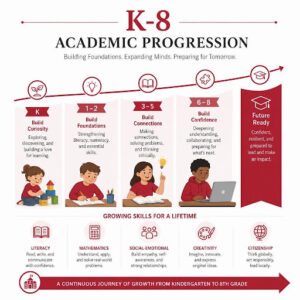
Effective curriculum design and instructional strategies are the engines driving academic excellence from kindergarten through eighth grade. They ensure that learning is engaging, relevant, and progressively challenging, catering to the evolving needs of students as they move through different developmental stages.
Implementing an Academically Advanced Curriculum Across Grade Bands
An academically advanced curriculum is characterized by its depth, breadth, and the way it encourages students to think critically and apply their knowledge. In primary grades, this might involve introducing concepts typically found in later grades, but adapted to be developmentally appropriate. For example, applied mathematics moves beyond simple arithmetic to incorporate real-world problem-solving, encouraging students to see the practical relevance of numbers. Structured literacy programs ensure that students develop strong decoding and encoding skills, alongside comprehensive understanding, forming the bedrock for all future learning.
As students progress into middle school, scientific inquiry becomes more sophisticated, moving from observation to hypothesis testing and data analysis. Critical analysis is honed through engaging with complex texts, historical events, and philosophical ideas, prompting students to question, evaluate, and form reasoned opinions. The strength of an academically advanced curriculum lies in its cross-curricular synthesis, where students learn to connect concepts across different subjects, recognizing the interconnectedness of knowledge. This approach not only deepens understanding but also prepares students for the interdisciplinary demands of higher education and professional life. We strive to provide an environment where students are consistently challenged to think beyond the surface, fostering a genuine intellectual curiosity that fuels continuous learning.
Bridging Transitional Stages from Elementary to Middle School
The transition from elementary to middle school represents a significant shift in a student’s academic journey. Elementary school often features a self-contained classroom model, where one teacher guides students through most subjects. Middle school, however, typically introduces departmentalized learning, with students moving between different teachers for specialized subjects. This requires students to develop greater organizational skills, time management, and self-advocacy.
To bridge this transition effectively, we focus on developing independent study habits and robust study skills. Students learn how to take effective notes, manage long-term projects, and prepare for exams across multiple subjects. The curriculum gradually introduces more abstract reasoning, encouraging students to move beyond concrete examples to understand complex theoretical concepts. Metacognition, or “thinking about thinking,” is explicitly taught, empowering students to understand their own learning processes, identify strengths, and address areas for improvement. Academic mentorship, where older students or teachers provide guidance and support, can also play a crucial role in helping students navigate the new academic and social landscape of middle school, ensuring a smooth and successful progression.
The Role of Learning Environments, Ratios, and Faculty Support
The physical and social learning environment, coupled with the quality and support of the faculty, profoundly impacts a child’s academic journey. These elements create the ecosystem in which learning flourishes, or, conversely, where potential may be hindered.
Low Student-Teacher Ratios and Differentiated Instruction
One of the most significant factors in fostering academic excellence is maintaining low student-teacher ratios. In smaller class settings, educators can provide more individualized attention to each student, understanding their unique learning styles, strengths, and areas needing support. This allows for effective small-group learning, where students can engage in targeted instruction and collaborative activities, receiving immediate feedback and clarification.
Differentiated instruction becomes far more feasible and impactful in such environments. Teachers can tailor their teaching methods, materials, and assessments to meet the diverse needs of students within the same classroom. This might involve providing tailored intervention for those who are struggling, offering targeted enrichment activities for advanced learners, or implementing flexible grouping strategies that allow students to work with peers at similar levels or with those who can offer different perspectives. Diagnostic evaluation is continuously employed to assess student progress and adjust instructional strategies accordingly, ensuring that every child is challenged appropriately and feels supported in their learning journey. This personalized approach helps to prevent students from falling behind while simultaneously pushing advanced learners to reach their full potential.
Family Engagement in Fostering Academic Excellence in K-8 Education
Academic excellence is a shared responsibility, and strong family engagement is an indispensable component. When schools and families work in partnership, they create a cohesive support system that reinforces learning both inside and outside the classroom. Open and consistent home-school communication is paramount. This includes regular updates on student progress, opportunities for parents to share insights about their child’s learning and development, and clear channels for discussing any concerns.
A robust parent-teacher partnership goes beyond formal conferences, fostering a collaborative spirit where both parties feel invested in the child’s success. This might involve workshops for parents on how to support learning routines at home, shared goals for academic accountability, and opportunities for families to participate in school events and activities. When parents are actively engaged, they are better equipped to create a supportive learning environment at home, reinforce positive study habits, and communicate the value of education. Furthermore, community involvement, such as inviting families to volunteer or share their cultural experiences, enriches the entire school environment and strengthens the bond between the school and its surrounding community, ultimately benefiting student achievement and well-being.
Frequently Asked Questions About K-8 Academic Growth
How does early childhood preparation impact performance in upper elementary and middle school?
Early childhood preparation serves as the foundational blueprint for all subsequent academic performance. Children who receive high-quality early education often demonstrate stronger early intervention skills, meaning they are better equipped to grasp new concepts and recover from learning gaps more quickly. This early exposure significantly boosts vocabulary acquisition, providing them with a richer linguistic toolkit that supports reading comprehension and written expression throughout elementary and middle school. Furthermore, a solid grounding in foundational numeracy concepts during preschool translates into greater ease with more complex mathematical operations later on. Perhaps most importantly, early education helps develop cognitive stamina—the ability to sustain attention and effort on challenging tasks—and fosters critical school readiness skills like following directions, working independently, and collaborating with peers. These skills are invaluable as students navigate the increasing academic demands of upper elementary and middle school.
What instructional strategies best support diverse learning paces within the same classroom?
Supporting diverse learning paces requires a flexible and multifaceted approach to instruction. Tiered assignments are highly effective, offering different levels of complexity or support for the same learning objective, allowing all students to engage with the material at their appropriate challenge level. Flexible grouping, where students work in various configurations (pairs, small groups, whole class) based on specific learning needs or tasks, allows teachers to provide targeted instruction. Multi-sensory instruction, which engages visual, auditory, and kinesthetic learning pathways, caters to different learning styles and helps solidify understanding for a wider range of students. Scaffolding—providing temporary support to help students master new skills and then gradually removing that support—is crucial for guiding learners through challenging content. Finally, continuous feedback, focused on specific areas for improvement rather than just grades, empowers students to understand their progress and take ownership of their learning.
How can educators measure academic excellence beyond standardized test scores?
While standardized test scores offer one snapshot of academic achievement, a comprehensive understanding of academic excellence requires a broader array of assessment methods. Portfolio assessments, which collect a student’s work over time, showcase growth, effort, and mastery of skills in a more holistic way. Project demonstrations allow students to apply their knowledge creatively, presenting their understanding through real-world applications, which often reveals deeper learning than a multiple-choice test. Peer evaluations encourage critical thinking and self-reflection, as students learn to assess their own work and that of their classmates against established criteria. Qualitative rubrics provide detailed descriptions of performance levels across various criteria, offering rich feedback on complex skills like critical thinking, collaboration, and creativity. Self-reflection exercises prompt students to analyze their own learning processes, identify strengths, and set goals for future improvement, fostering metacognitive awareness that is vital for lifelong learning.
Conclusion
The journey of fostering academic excellence in K-8 education is a continuous and evolving process, beginning with the earliest educational experiences and building progressively through each grade level. We have explored the critical role of a strong early foundation, the integration of social-emotional learning, and the deliberate design of curricula and instructional strategies. We’ve also highlighted the profound impact of supportive learning environments, low student-teacher ratios, and robust family engagement. By prioritizing these comprehensive developmental aspects, we aim to cultivate not just academically proficient students, but well-rounded individuals equipped with the critical thinking, resilience, and curiosity necessary for sustainable achievement and lifelong learning. Our commitment is to guide each child along an academic trajectory that maximizes their potential and prepares them to thrive in an ever-changing world, ensuring educational equity and opportunity for all.