
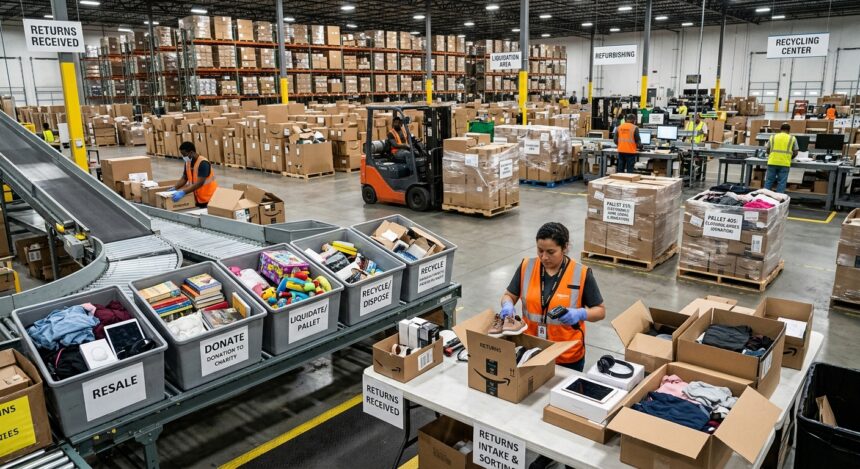
What Actually Happens to the Things You Send Back
I returned a slow cooker last spring. Wrong size, entirely my fault, and back it went with the prepaid label. I did not think about it again until a friend asked where returned things go, and I realised I had assumed the answer was “back on the shelf.”
It is not. Once a carton is opened, that unit generally cannot be sold as new again — not because anything is wrong with it, but because of how “new” is defined. My slow cooker, which had been out of the box for nine minutes, was now a different category of inventory.
Understanding where it went turns out to be genuinely useful if you buy anything for a household.
The returns stream, briefly
Returned goods sort into a few destinations. A small share goes back to the manufacturer. A share is genuinely broken and gets recycled or destroyed. The largest share — the wrong-size, wrong-colour, changed-mind, duplicate-gift category — is perfectly functional and enters the secondary market.
From there it moves in one of two ways.
By the pallet. Bulk lots sold unsorted and unseen, by weight or by skid. This is how most of it moved for years, and it is a reseller’s business: you buy sixty items hoping the good ones outweigh the broken ones. For a household, it is a terrible deal dressed up as an adventure.
Individually listed. Each unit inspected, graded and listed on its own with its condition stated. This is the part that changed, and it is the part worth knowing about, because it turns a lottery into ordinary shopping.
The grade is the whole thing
Every listing in the second channel carries a condition grade, and they map to a short scale: new and sealed, opened but complete, light wear, visible wear, or as-is where something is missing or untested. The grade should be attached to the specific unit, not to the product line — a real listing says what was found on this one.
The difference in practice: a product-line description tells you what a slow cooker is. A unit listing tells you the box was opened, the ceramic insert is present, there is a two-centimetre scuff near the cord, and it powered on. That second listing is one you can make a decision about.
What I check now
- The missing-parts line. Good listings name what is absent. That is where a bargain turns into a project — a bread maker without its paddle, a vacuum without its wall mount.
- Whether as-is stock is kept separate. Sellers who put faulty and incomplete items in their own section, priced accordingly, are grading honestly. Sellers who blend it all together are not.
- The return window. Thirty days of returns and free exchanges is what makes this sensible. It gives you time to run the thing through a real week rather than a first look.
- Shipping thresholds. On a $30 item, shipping decides whether the discount survives.
Where it is worth doing and where it is not
Best value, in my experience: small kitchen appliances, vacuums, air purifiers and fans, kids’ gear that gets outgrown in a season anyway, storage and organisation, seasonal items bought off-season.
Not worth it: car seats, helmets, mattresses — anything whose safety depends on a history you cannot see. Sealed consumables. And anything you would only be buying because it is cheap, which is not a saving in any category.
For Canadian households specifically
The individually listed channel has grown quickly here, and the useful practical guides are now Canadian rather than adapted from US sources — shipping thresholds, provincial pickup options and return windows all differ. If you want the mechanics laid out properly, this guide on where to buy Amazon returns in Canada covers the channels, the condition grades and what each one is actually worth.
The bottom line
My slow cooker is somewhere out there, graded “like new, opened box, complete,” and somebody paid about half what I did for a machine I used for nine minutes. That is not a scandal. It is just what happens to the enormous volume of things households send back — and once you know the grading vocabulary, it is a category you can shop deliberately instead of avoiding.