
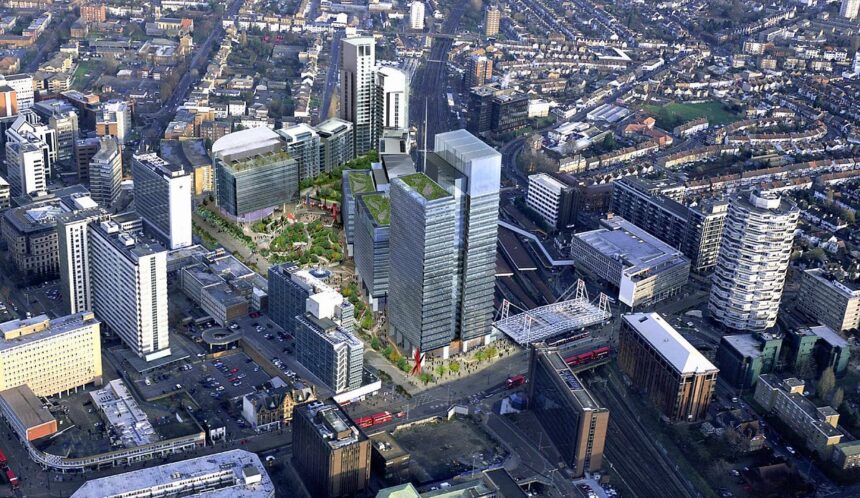
Croydon processed approximately 3,200 householder planning applications across the twelve months to the most recent published figures, one of the highest volumes in Greater London by borough. The scale of that residential development pipeline reflects Croydon’s specific position as both a designated Metropolitan Centre and a borough with substantial suburban stock ripe for extension activity.
The market data below sets out where the volume actually sits, which extension types dominate, and what the numbers say about where Croydon extension applications are heading. Practices working as Croydon architects and planning consultants have seen a shift in recent years.
The borough’s regeneration zones now absorb new build projects and home improvement work.
Application Volume by Extension Type
Croydon’s householder application data breaks down across a small number of dominant categories. Single storey rear extensions consistently top the volume, followed by loft conversions, then double storey extensions, then multi component briefs combining several project types.
| Extension type | Approximate share of Croydon householder applications | Typical approval rate |
| Single storey rear extensions | 42 percent | 82 percent |
| Loft conversions | 24 percent | 78 percent |
| Double storey extensions | 15 percent | 65 percent |
| Combined single + loft | 9 percent | 72 percent |
| Wraparound extensions | 6 percent | 60 percent |
| Basement conversions | 2 percent | 55 percent |
| Other | 2 percent | Variable |
The approval rate variation tells its own story. Single storey work clears at high rates because the design footprint is predictable and neighbour amenity impact is contained. Double storey and wraparound schemes drop noticeably because the massing arguments become harder to defend against 45 degree rule tests.
Regeneration Zone Impact on Application Density
Croydon’s designated regeneration areas concentrate a disproportionate share of both residential and mixed use applications. The West Croydon growth area, East Croydon Metropolitan Centre, and the wider Growth Zone corridor generate elevated application activity compared to peripheral suburban wards.
Application density inside the Growth Zone runs approximately 40 percent higher per head of population than in Croydon’s outer suburban wards. That density comes primarily from three drivers.
Property price uplift across the regeneration corridor makes extension investment viable at higher spend levels. Rental yield opportunities on multi unit conversions inside the growth boundary encourage developer led applications. Tube and tram connectivity around East Croydon and West Croydon station catchments raises the value ceiling on completed extensions.
Double Storey Extension Performance Data
Croydon double storey extensions cleared at 65 percent approval on first submission across recent completed cycles. The 35 percent refusal rate concentrates around three specific reasons.
Overshadowing of neighbouring gardens accounts for approximately 40 percent of Croydon double storey refusals. The 45 degree rule applied to first floor windows on adjoining habitable rooms fails on ambitious rear extension depths that would have passed as single storey builds. Massing objections against the street scene account for another 30 percent, particularly where the proposed rear elevation dominates the original property.
Neighbour objection density accounts for the remaining share. Applications with 5 or more written objections during the 21 day consultation clear at approximately 40 percent versus 72 percent for applications with fewer than 2 objections. Well managed double storey briefs address neighbour concerns before submission rather than during consultation, which is where a properly resourced double storey extension design approach separates approved schemes from refused ones.
Loft Conversion Market Data
Loft conversions across Croydon deliver value uplift ranging from 12 to 22 percent depending on finish quality and floor area gained. The variation reflects a bimodal distribution rather than a smooth curve.
At the lower end, dormer conversions with basic finishes on standard suburban semi detached stock deliver 12 to 15 percent uplift. At the upper end, L shaped dormer conversions with ensuite bathrooms on Victorian and Edwardian terraces closer to central Croydon deliver 18 to 22 percent.
The middle of that range represents the largest share of completed schemes. Median value uplift on Croydon lofts sits at approximately 16 percent based on comparable resale data.
Cost Data Patterns
Standard extension construction costs in Croydon run approximately 5 to 12 percent below equivalent projects in inner London boroughs. The saving concentrates on trade labour rates and site logistics costs, which are lower outside the M25 congestion zone.
Material costs run at similar national market rates. Contractor overheads are lower. Delivery times to Croydon sites tend to be predictable given road access via the A23 corridor.
The saving disappears on premium specifications. Cobham Croydon border properties targeting high end finish levels typically match or exceed central London build costs once the specification is factored in.
Article 4 and Conservation Area Coverage
Croydon operates Article 4 Directions across selected conservation areas but the coverage sits significantly below inner London boroughs like Camden or Kensington and Chelsea. Approximately 4 percent of Croydon addresses sit inside conservation area boundaries against 12 to 25 percent in inner boroughs.
That coverage difference matters materially for extension applications. Permitted development remains a viable route on the majority of Croydon suburban stock in ways that don’t apply consistently in inner London terraced neighbourhoods.
Conservation zones that do apply concentrate around Croydon Old Town, Shirley Park, and pockets of central Croydon. Applications inside these zones face the standard heritage assessment tests and typically require full planning rather than PD.
Where the Croydon Market Is Heading
The volume trajectory across Croydon householder applications continues to rise year over year, driven by three underlying factors. Regeneration zone property price uplift makes extension investment increasingly viable. Growing family demographics across the suburban wards produce sustained brief demand. Rental yield opportunities on multi unit conversions inside the Growth Zone attract developer capital.
The market segment most likely to expand fastest over the next 24 to 36 months sits in the combined single storey plus loft category, which currently represents 9 percent of applications but delivers the largest combined value uplift per property. Families choosing to invest once at a higher spend level rather than phase two separate projects over years produce the applications most likely to feature in the next volume cycle.
Croydon’s fundamentals point toward continued residential development activity through this decade. Application volumes will likely track upward with the borough’s regeneration timeline.